Chase van de Geijn

ML Physicist

About Me
Interests
Blogs
Education
Research
Teaching
Supervision

About Me

Profile Image

Welcome to my Theory of Everything!

Howdy! I'm Chase van de Geijn, a eccentric AI Researcher and Orange Enthusiast with an interest in understanding AI at a deep mathematical level. I was doing my PhD at the University of Göttingen mainly focusing on Foundation models for Neuroscience. In the past, I had started a PhD in Edinburgh in Applied Math target towards Geometric DL for Fluid Dynamics. I am also a co-organizer of the NeurReps Workshop in 2024 and 2025, but have stepped away to focus on teaching a GDL course this year.

Research Interests

My main specialty is in Geometric Deep Learning particularly Clifford Algebra. However, I also have done work in Bayesian Neural Networks, Wavelet Theory, AI4Histopathology and have recently gotten into Computational Neuroscience, particularly sparse coding, Vector Symbolic Architectures, and geometric perception/neurogeometry. Generally, I can be described as a highly opinionated, goofy guy, who loves to learn and teach.

Personal Interests

In my free time, I enjoy walking, baking, and board games. I am also an enthusiast of the color orange and Dungeons and Dragons. I am an avid fan of Dimension 20 and Dungeons and Dads.
Education

PhD
Master's Degree
Bachelor's Degree

Supervision

Supervision

Interests

Clifford Algebra
Geometric Deep Learning
Fluid Dynamics

Blogs

Positional Encodings

Research

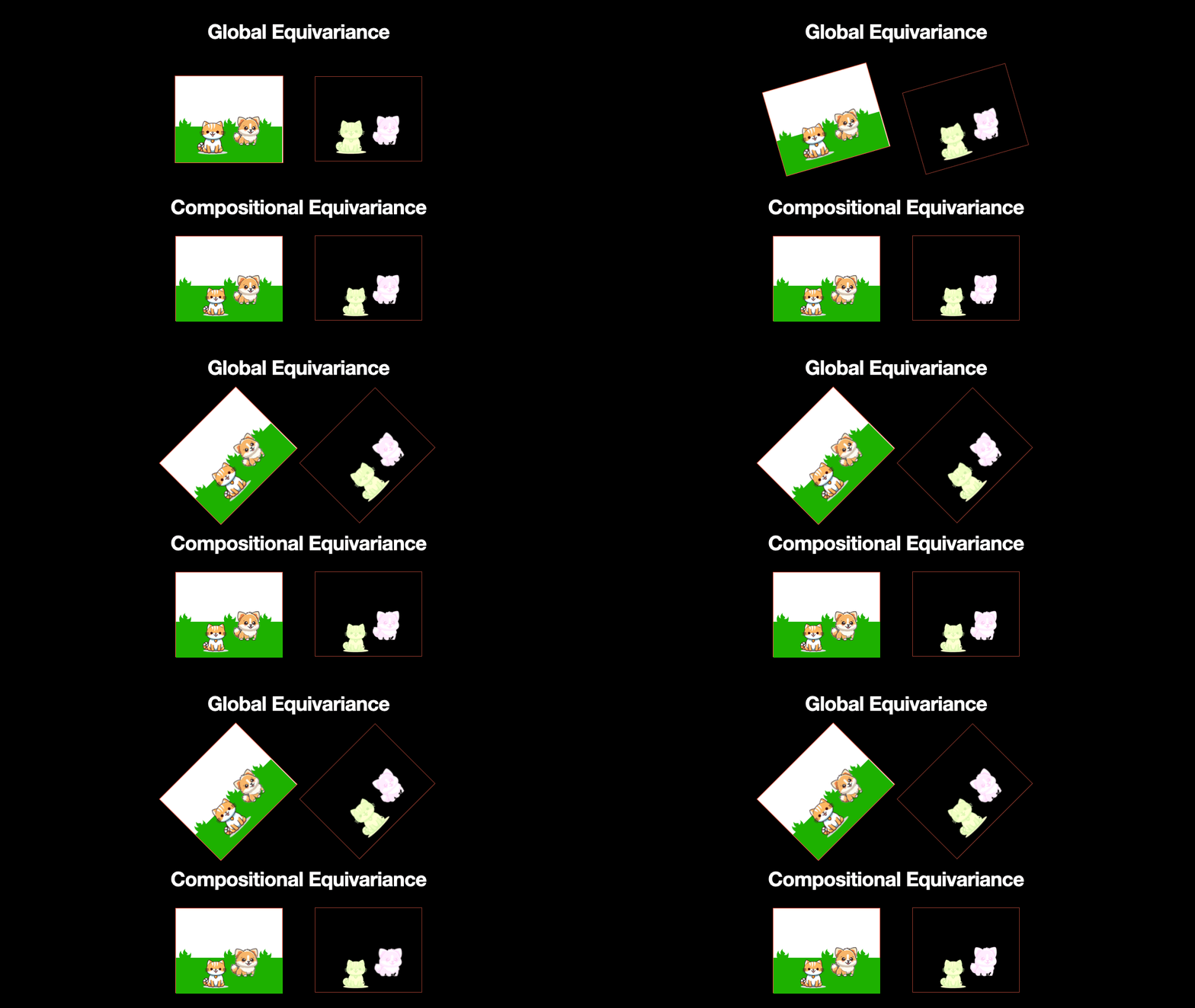
Hierarchical Equivariance
Equivariant Neural Fields
Group Generalized POD
Cake Wavelets

Cake Wavelets

One of the original geometric deep learning~\cite{bronstein2021geometric} architectures achieved equivariance by extending the classical 2D translation convolutions to group convolutions \cite{bekkers2018roto, cohen2016group}. Because images can be treated as scalar (or RGB) fields over 2D, convolving over 2D translations results in another 2D scalar field as an output, thus the layers of a convolutional neural network are endofunctions, and more specifically endomorphisms as they are linear operators. However, for the more general group convolutional, the output is a field over the group -- e.g. for the roto-translation group SE(2), the result will be a field with three parameters \((x,y,\theta)\) -- regardless of the input dimensions. As a result, the first group convolution layer changes the domain while the subsequent layers are endomorphisms up until the final layer, which projects from the group to the output domain.

This discrepancy between the layers' dimensions has led to distinguishing between lifting, convolutional, and projection layers within the architecture. In the case of regular group convolutional networks, the lifting layer follows directly from the structure of group convolution operation. However, for architectures such as PDE-GCNNs~\cite{smets2023pde}, the layers are defined strictly as endomorphic due to the nature of the PDEs being solved. This means that the lifting must be done by a separate operation. This is the same problem in Geometric Clifford Algebra networks~\cite{ruhe2023geometric, ruhe2024clifford} in which the image must first be embedded into the Clifford algebra.

This can be resolved by determining a lifting and projection layer. While this can be, and often is, learned, it is beneficial to have a principled way to lift into the group by using a fixed lifting kernel. This can also be done in regular GCNNs allowing added mathematical interpretability. Since we can limit tunable parameters of the neural network to the convolutional layers, one can interpret the network as just the portion of the model that is an endomorphism over the group.

A natural question arises of what constitutes the optimal method to lift into the group. From the theory of directional wavelets, we propose two major properties that a fixed lifting operation should have: reconstructability~\cite{janssen2018design} and locality/sparsity~\cite{bengio2013representation}. In this work, we motivate orientations score transforms with Cake Wavelets~\cite{duits2005perceptual, duits2007image} to be the near-optimal way to lift to a discretized group of roto-translations. In this abstract, we will motivate Cake Wavelets through numerical optimization. However, there is a more rigorous mathematical derivation via the general uncertainty principle that could be presented if time permits for a full paper.

Group Convolutions

Much of the success of convolutions in computer vision is attributed to their translation equivariance. In this work, we will refer to convolutions and correlations synonymously and use the continuous form of convolutions,

\begin{align} \llbracket f \ostar ~k \rrbracket (\tau) &= \int_{\mathbb{R}^2} f(x) k(x-\tau) dx \\ &= \int_{\mathbb{R}^2} f(x) T_\tau\llbracket k\rrbracket(x) dx \\ &= \left< f, T_\tau\llbracket k\rrbracket \right> \end{align}

where \(k\) is the kernel, \(f\) is the input image, and \(\tau\) is a coordinate in the activation map, ie the output domain, and \(\left< \cdot, \cdot \right>\) denotes the inner product of two functions. The translation operator \(T_\tau\) is defined as \(T_\tau \llbracket k\rrbracket(x) = k(x-\tau)\).

The core of a group convolution is to replace the translation operator with an arbitrary left-regular group action, \begin{align} \llbracket f \ostar_{~G} k \rrbracket (g) &= \int_{\Omega} f(x) \mathcal{L}_g\llbracket k\rrbracket(x) dx \end{align} Notice that the output is a field over the group \(G\) and not the input domain \(\Omega\). This form of convolution is not new and has been used in the context of wavelet theory, and alternatively called a wavelet transform, where \(k\) is referred to as a mother wavelet. In the context of wavelets, the lifting operation to SE(2) is often referred to as the orientation score transform. This link will let us leverage the literature on wavelet optimality to determine an appropriate fixed lifting kernel. We will focus on two wavelet properties as criteria for optimality: the fast reconstruction property and locality.

Fast Reconstruction

For a fixed kernel in a lifting layer to be useful, it should retain the model's ability to be a universal approximator. This means that the lifting layer should not contaminate the input signal, ie lose information. The reconstruction property of a wavelet ensures that the lift is invertible which guarantees that the information is retained. Within orientation score transforms, there is a more restrictive property known as the fast reconstruction property~\cite{janssen2018design}. This property ensures that the image, \(f\), can be reconstructed from its orientation score transform, \(U_f\), by summing over the orientation axis.

\begin{equation} f(i,j) = \sum_{\theta} U_f (i,j,\theta) \end{equation}

Rather than the more general reconstruction property which ensures that information is retained \textit{somewhere} in the orientation score, the fast reconstruction property ensures that a pixel's information is fully contained in the orientation axis. From this property, we get the following constraint on the kernel,

\begin{align} \sum_{\theta} U_f (i,j,\theta) &= \sum_{\theta} \left<~f~, ~\mathcal{L}_{(i,j,\theta)}\llbracket k\rrbracket \right> \\ &= \left< f, \sum_{\theta} \mathcal{L}_{(i,j,\theta)}\llbracket k\rrbracket \right>, \end{align}

This implies that summing over orientations of the kernel should yield the identity operator of a convolution, ie a delta function, or equivalently a constant function in the Fourier domain.

Localization

The fast reconstruction property restricts the wavelet to sum to a delta function. However, this does not have a unique solution. For example, the trivial solution to fast reconstruction property would be the kernel which is itself a delta function that is weighted by \(\frac{1}{N_\theta}\) where \(N_\theta\) is the number of orientations. This kernel results in the copying of the input image to each orientation channel. In the trivial solution, the information is \textit{maximally entangled} as the pixel information is completely spread out over the orientation axis. We would rather observe a sparse set of activations in the orientation axis as this would allow us to attribute the information to a specific orientation ie for the response to be localized.

We can quantify locality with the spread of activations. Spread is synonymous with uncertainty, or variance, in probability, but the kernel is not a probability distribution. Borrowing from the uncertainty principle of quantum mechanics, we can interpret our wavelet as an unnormalized probability amplitude. Thus, we can quantify the spread of activations across orientations with the variance along the fiber. Moreover, it can be shown\footnote{There is not room in this abstract, so it is simply assumed.} that minimizing the spread of the activations in the orientation axis is equivalent to minimizing the variance of the kernel.

Regularity

It is often useful in practice to impose an extra regularization constraint on the locality of the wavelet itself. While the previous localization term imposes localization on the responses when preforming a convolution, this imposes locality in the frequency domain, and not the spatial domain. One can add an additional term to encourage localization in the spatial domain. If viewing the wavelet in the Fourier domain, this translates to imposing a smoothness term and minimizing the gradient of the wavelet. This is often associated with the \textit{condition number} of the wavelet.

$$\mathcal{L}_{cond} = |\nabla \hat{k}|^2$$

Numerical Optimization

The fast reconstruction and localization conditions lead to the following loss functions for numerical optimization, \begin{equation} \mathcal{L} = \mathcal{L}_{\text{reconstruction}} + \lambda \mathcal{L}_{\text{localization}} \end{equation} where the reconstruction loss is the squared error between the summed kernel and the identity, \begin{equation} \mathcal{L}_{\text{reconstruction}} = \sum_{i,j} \left( \mathbb{I} - \sum_{\theta} \mathcal{L}_\theta \llbracket k \rrbracket (i,j) \right)^2 \end{equation} and the localization loss is the variance of the kernel, \begin{equation} \mathcal{L}_{\text{localization}} = \sum_{i,j} \left|\\mathtext{arctan}\left(\frac{j}{i}\right) - \bar{\theta}\right|^2 ~p(i,j) \end{equation} where \(p(i,j)= \frac{|k(i,j)|^2}{\sum_{x,y}|k(x,y)|^2}\) and \(\bar{\theta}\) is an arbitrarily determined target Fréchet mean orientation.

Cake-Wavelet

...

Theoretic Derivation

While we show that the numerical optimization tends to look like Cake-Wavelets, we would like to theoretically derive the optimal wavelet. In this section, we propose a derivation of the optimal coherent state for lifting to a discretized SE(2).

Uncertainty Principle

The optimality of Gabor Wavelets with respect to position-momentum is well known in signal processing and computational neuroscience. These wavelets can be derived from the Heisenberg Uncertainty Principle, given by the Cauchy-Schwartz inequality,

$$ <\hat{X}^2>_\psi <\hat{P}^2>_\psi \geq \frac{1}{4} \hbar^2 $$

where \(\hat{X}\) and \(\hat{P}\) are the position and momentum operators. This equation means that the variance of the position of a wavefunction \(\psi\), given by \(<\hat{X}^2>_\psi\), and the variance of the momentum, given by \(<\hat{P}^2>_\psi\), cannot be arbitrarily small at the same time. Strict equality for a function \(\psi^*\) holds when,

$$ \hat{X}[\psi^*] = i\lambda \hat{P}[\psi^*] $$

For the position operator, \(X[\psi] = x\psi\), and momentum operator, \(P[\psi] = i\hbar \frac{\partial}{\partial x}\), equality holds for the Gaussian, or more generally \textit{Gabor}, wavefunction.

More generally, the Uncertainty Principle can be generalized to $$ <\hat{X}^2>_\psi <\hat{Y}^2>_\psi \geq <\frac{1}{2} [\hat{X}, \hat{Y}]^2>_\psi $$ where \([\hat{X}, \hat{Y}]\) is the commutator, or Lie bracket, of the operators \(\hat{X}\) and \(\hat{Y}\).

If we consider the generators for position and orientation, \(\hat{X}\) and \(\hat{\Theta}\), we can derive the optimal wavelet for lifting to SE(2). The generators are given by the operators, $$ \hat{X} = x\frac{\partial}{\partial x} + y\frac{\partial}{\partial y} $$ $$ \hat{\Theta} = \frac{\partial}{\partial \theta} $$ where \(x\) and \(y\) are the position coordinates, and \(\theta\) is the orientation coordinate. Thus, \(\psi^*\) is optimal when, $$ \frac{\partial}{\partial \theta}\psi^* = \frac{\rho}{\lambda} \sin \theta \psi, $$ making \(\psi^*\) $$ \psi^* = \frac{1}{C(\rho)} e^{\frac{\lambda}{\rho} \cos \theta}, $$ which is the Von Mises distribution. If we consider the continuous form of the fast reconstruction constraint, $$ \int_{0}^{2\pi} \frac{1}{C(\rho)} e^{\frac{\lambda}{\rho} \cos \theta} d\theta = 1 $$ we can solve for \(C(\rho)\) as the normalization constant of the Von Mises distribution, which is given by $$ C(\rho) = 2\pi I_0(\frac{\lambda}{\rho}). $$ This gives the optimal wavelet if we consider the continuous form of the fast reconstruction constraint. However, for the discrete form, we must consider the discretization of the SE(2) group.

Slicing

To account for the discretization of the SE(2) group, we must propose a rearrangement of the fast reconstruction property, by partitioning the integral. For a continuous Lie group \(G\), we can restate the fast reconstruction property as $$ \int_{G} \psi_g dg = \mathbb{1} $$ then we can partition the integral as $$ \int_{G} \psi^*(g) dg = \sum_{h\in H} \int_{G/H} \psi_{hg} dg = \mathbb{1} $$ for some discrete subgroup \(H\) of \(G\). We can then consider the optimal wavelet, \(\phi^*\), for the discrete subgroup \(H\), in terms of the optimal wavelet for the full group, \(\psi^*\), by integrating over the quotient space \(G/H\). $$ \phi^*_h = \int_{G/H} \psi^*(hg) dg $$ Thus, we can derive the optimal wavelet for the discrete SE(2) group by integrating the Von Mises distribution over the quotient space of the SE(2) group, $$ \phi^*_0 = \int_0^{\pi/N} \frac{1}{C(\rho)} e^{\frac{\lambda}{\rho} \cos \theta} d\theta $$

Smoothness Penalty

When considering the smoothness penalty, the continuous coherent state becomes that of SIM(2), rather than SE(2). This was derived in JP Antoinne's paper. As SE(2) is a subgroup of SIM(2), one can obtain the von Mises distribution by integrating over the quotient space of SIM(2)/SE(2) using the above slicing trick. (I think this is the case, but I am not sure. I need to check this.)

Results

The results of running this optimization in the Fourier domain are shown in Figure \ref{fig:opt}, where the kernel. The kernel converges to a ``wedge" in the Fourier domain which is equivalent to the \(B_0\) Cake Wavelet.

A more rigorous derivation can be done via the Uncertainty Principle to further motivate the general family of Cake wavelets to be optimal for lifting to the discretized roto-translation group, but that is beyond this abstract. Moreover, there is an extension of the Uncertainty Principle to Clifford algebras and Clifford wavelets~\cite{banouh2019clifford}, which has potential implications for the embedding of images in Clifford networks.

Subtab Image

Skills

Teaching

Teaching

I am passionate about teaching and take every opportunity to share my knowledge with others. I have experience as a teaching assistant in both Bachelor's and Master's level courses.

  • Autonomous Mobile Robots : UvA AI, Bachelors Level
  • Applied Machine Learning : UvA Datascience, Bachelors Level
  • Machine Learning 1 : UvA AI, Masters Level

I frequently give colloquium lectures about my research for various groups at the University of Edinburgh. I have given the following lectures:

  • Hierarchical Geometric Deep Learning : Pure Math for AI - Post Graduate Applied Math Colloquium , The University of Edinburgh, May 2024
  • Lifting to SE(2) should be a Piece of Cake - Machine Learning Reading Group, The University of Edinburgh, April 2024
  • Lifting to SE(2) should be a Piece of Cake - Redwood Center of Theoretical Neuroscience Berkeley, Dec 2023
  • Lifting to SE(2) should be a Piece of Cake - Machine Learning and Simulation Science Lab, University of Stuttgart Aug 2023
  • Learning the Schrodinger Equation with Uncertainty with Bayesian Neural Networks - AMLab, University of Amsterdam June 2019
  • Wavelet Theory for Signal Processing

Subtab Image